The twins of the stellar world are binary star systems.
A binary star is a
star system consisting of two stars orbiting around their common center
of mass.
When two stars appear close together in the sky as seen from the Earth when viewed through
an optical telescope, the situation
is known as an “optical double”.
This means that although the
stars are aligned along the same line of sight, they may be at
completely different distances from us. This occurs in constellations;
however, two stars in the same constellation can also be part of a
binary system
Why study Binary stars ?
Binary star systems are very important in astrophysics because
calculations of their orbits allow the masses of their component stars
to be directly determined, which in turn allows other stellar
parameters, such as radius and density, to be indirectly estimated.
This
also determines an empirical mass-luminosity relationship (MLR) from
which the masses of single stars can be estimated.
Also,it is estimated that 75% of the stars in the Milky Way galaxy are
not single stars, like the Sun, but multiple star systems, binaries or
triplets.
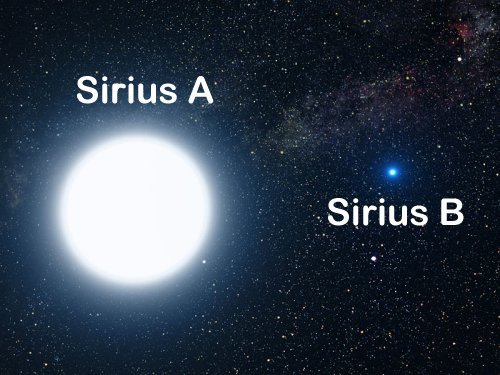
The Brightest star in the sky is a binary.
This is true. Sirius (aka the Dog star) – the brightest star in the sky is actually a binary star system.
When it was discovered in 1844 by the German astronomer
Bessel, the system was classed as an astro-metric binary, because the
companion star, Sirius B, was too faint to be seen.
Bessel, who was also
a mathematician, determined by calculations that Sirius B existed after
observing that the proper of Sirius A (the main star) followed a wavy
path in the sky, rather than a uniform path.
Sirius can now be studied
as a visual binary because, with improving technology and therefore
improved telescopes, Sirius B was able to be seen, although not for 20
years after Bessel had correctly predicted its existence.
Black Holes in a binary system ?
Hell Yeah! The term “binary system” is not used exclusively for star systems,
but also for planets, asteroids, and galaxies which rotate around a
common center of gravity.
However, this is not a trick question; even in
star binaries, the companion can be a black hole.
An example of this is
Cygnus X-1.
A binary Black Hole system ?
Definitely!
A binary black hole (BBH) is a system consisting of two black holes in close orbit around each other.
In fact the LIGO experiment which confirmed the existence of Gravitational waves was able to acquire its data when two Binary Black Holes Collided and merged into one. This phenomenon sent ripples in the fabric of space-time which we call as a Gravitational Wave.






 Key and Teeth