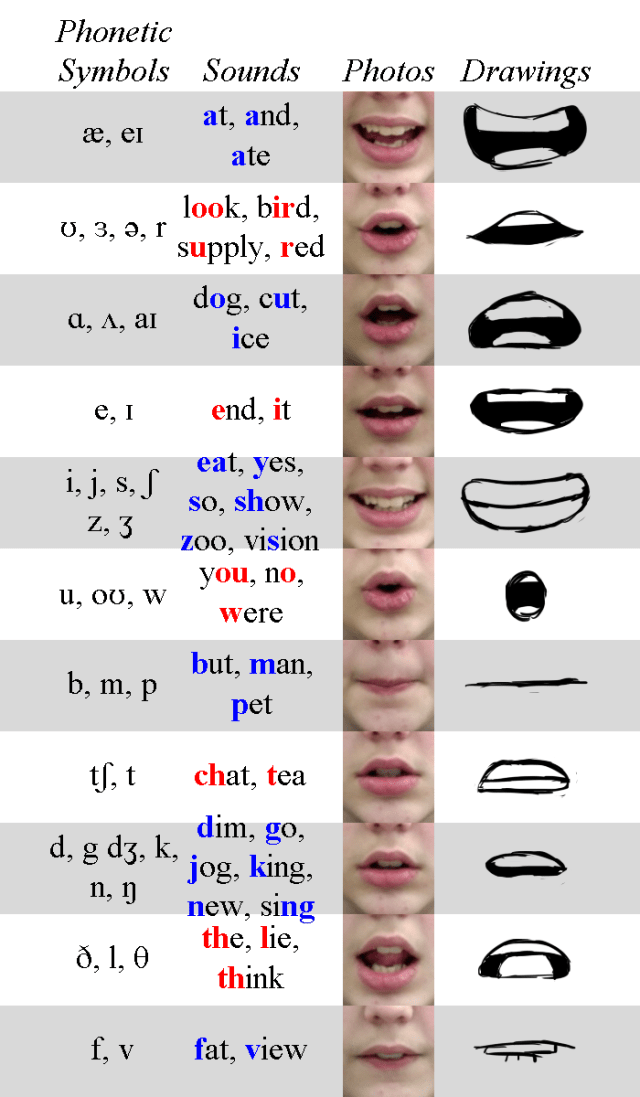
This is a nice chart! Lipsync is one of my not-so-secret passions. I also hate front mouths. They’re harder to inbetween, I find, and they’re not used nearly as frequently. Here’s some ¾ mouths I made.
These are the basic shapes I was taught, and I use. Standard lipsync shapes;;
You have your closed mouth to open, to clenched teeth, to oohs, and your (often optional) F, L, and TH mouths.
Tips!
Your top teeth don’t move; I mean, stylistically it happens sometimes (Gravity falls does it fairly well, as much as I haaaaate that), but your lipsync will prolly look better if they don’t.
My clenched teeth (SH) mouth is always a bit wider than my biggest AH mouth. It adds variation and helps your shapes blend more nicely. Conversely, my biggest AH mouth is narrower than my SH mouth and my closed (M) mouth.
My L mouth is a tiny bit more closed than my biggest AH, and not as closed as my second biggest AH. It fits between them nicely so that if you have to go from an L to an AH mouth, like you would for the word “Like” or “Love”, it doesn’t pop or look weird.
My R and oo mouths move forward on the face a bit, it adds dimension, and if you leave it all in the same place and have the mouth just shrink into a circle it miiiight look weird.
Aaaaand I think that’s it? Never go from a SH mouth to a TH mouth, it’ll pop and look weird…uhhh;
Also! It’s alright to skip some shapes;;
So below is a lipsync I made using the above shapes;
It’s clear what they’re saying, the mouth is moving nicely, but there’s only one problem. Veeeery rarely do they give you enough time to use all the mouths you want to make it move nice. Voice actors talk fast to fit everything in and holycrap do we hate love them for it.
So here’s a fast one.
Those two gifs should start at the same time, and notice that the second one stops while the first one is still saying “doing”.
I not only cut out the mouth between the biggest AH and the clenched teeth, but I combined the word “Are you” into, like, 3 shapes. I also trimmed some inbetweens overall. The lipsync still reads, though! You can still tell what they’re saying even without audio (which would help it a bit, haha~)
Cutting out that stuff ended the lipsync a whole 14 frames sooner (more than half a second!). It doesn’t sound like much, but with 24 frames per second and dialogue moving at the speed of light, you don’t have time to dilly dally. This isn’t a preschool show;;
Aaaaaand I think that’s it. Liiiipsyyyyyync~~~
Now to go back to actual work and stop talking about things most ppl don’t care about;
The first diagram makes a weird and unnecessary distinction between t, tʃ and d, dʒ – the only difference between the two is voicing, which happens at your vocal cords aka way down in your throat. In fact, you’d probably want to distinguish between t, d versus tʃ, dʒ instead, as the second pair both tend to come with lip-rounding, at least in English. But the second guide is good!
Note also that the reason it’s possible to make a fairly straightforward guide to animating speaking lips is the same reason that lipreading is difficult – most sounds are produced inside the mouth where we can’t see them.


 Key and Teeth