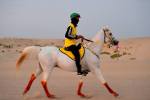
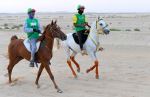
Sometimes endurance horses in the Middle East have vividly red lower legs, which I have been baffled by for a while now, but as it turns out, the red is from henna (Lawsonia inermis), which is used to prevent the skin from cracking on the sandy tracks. In fact, henna has been used for a very long time in a protective capacity as well as a decorative one: it protects against mud fever and sunburn, and was also used to harden hooves and accelerate the healing of galls and saddle sores.
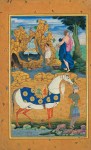
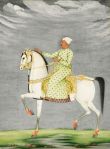
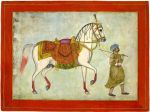
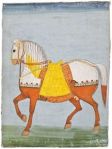
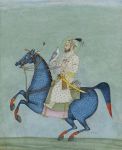
A quick search through Persian and Mughal art will also turn up images of horses with hennaed legs, or even bellies, and sometimes manes and tails, showing that the use of henna is a long-standing one, dating back hundreds of years.
Photos © Boudheib Initiative Endurance.
Pictures (clockwise from left): miniature of horse and groom from the Muraqqa’-e Golshan, Persian, sixteenth or seventeenth century; equestrian portrait of a Nawab riding a grey stallion, signed by Muhammad Reza-i Hindi, Mughal, 1763/4; late eighteenth century Mughal album leaf from the British Museum; an equestrian portrait of Emperor Shah Jahan, Mughal, early nineteenth century; a stallion, Marwar, North India, late eighteenth century (note that this horse is probably a double dilute, as his muzzle, hooves and genitalia are peach coloured, as opposed to the grey and blue used for the other horses; as a double dilute he would be prone to sunburn and would need protection this extensive).
Sources
Kip Mistral. ‘Henna For Horses: Ancient Decorative and Medicinal Traditions’.
Sandra L. Olson. ‘Insight on the Ancient Arabian Horse from North Arabian Petroglyphs’.
Encylopaedia Iranica. ‘Henna’.
 Key and Teeth